The book on every rigger's shelf
If there is one reference that belongs next to your bench, it is The Ashley Book of Knots by Clifford W. Ashley, first published in 1944. Ashley spent years recording knots from sailors, riggers and fishermen, and the book numbers well over three thousand of them, each drawn by hand. You will never need most of them, but browsing its pages teaches you how knots are named, how they are grouped and why one works where another slips. Pair it with a simple modern pocket guide for the everyday knots, and you have a complete library.
Building a knot board
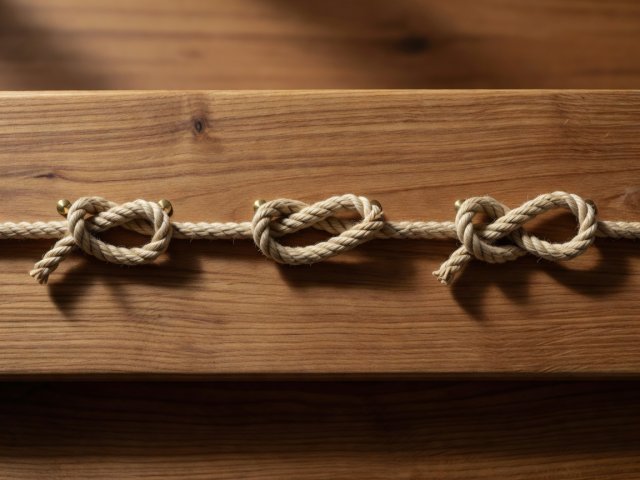
A knot board is the perfect first ropework project because it teaches consistency. Every knot is tied in the same rope, dressed neatly and mounted so it can be read at a glance.
- Choose the rope. Natural manila or a hemp-look synthetic about 6 to 8 mm thick looks traditional and photographs well. Buy more than you think; you will retie many knots.
- Pick your twelve. A useful set: reef knot, sheet bend, bowline, clove hitch, round turn and two half hitches, figure-eight, sheepshank, rolling hitch, carrick bend, timber hitch, fisherman's bend and a monkey's fist.
- Tie and dress. Dressing means arranging the knot so no parts cross unnecessarily. A dressed knot is stronger and handsomer.
- Whip the ends. A common whipping of waxed thread stops the rope fraying. It looks far better than tape or melted ends.
- Lay out on paper. Arrange all knots on a sheet the size of your board before committing, leaving room for labels.
- Mount and label. Fix each knot from behind with thin brass wire through small drilled holes, then add printed or engraved labels.
Decorative knots that follow rules
Turk's head. A woven ring of rope that sits around a rail, a tiller or the neck of a bottle. It is described by two numbers: leads (how many strands run around) and bights (how many scallops on each edge). A three-lead, four-bight Turk's head is the classic starter and can be tied around your fingers. Once tied, you follow the first pass two or three more times to double or triple it.
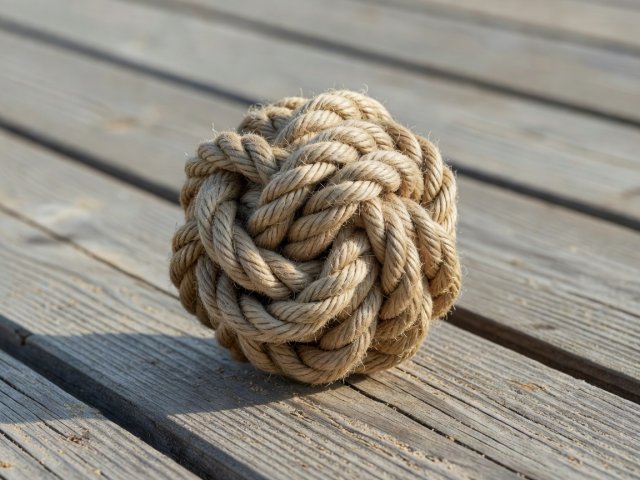
Monkey's fist. Three sets of turns wrapped at right angles around a small core, originally to weight a heaving line. Today it makes a handsome key fob or doorstop.
Coachwhipping and cockscombing. Coverings of plaited or half-hitched cord used on stanchions and handrails. On a small scale, the same techniques dress a model's tiller or a display stand.
Bell ropes. A short length of rope decorated with a sequence of these knots, ending in a tassel. Traditional ship's bells were rung with them, and a good bell rope is a fine showcase of everything above.
Other sailor arts
Sailor's valentines. Octagonal wooden boxes filled with intricate mosaics of tiny shells, usually in star or heart patterns. Many nineteenth-century examples were made in Barbados and sold to visiting sailors as gifts for home. Making one today is a meditative winter project with craft-store shells and a hinged frame.
Scrimshaw. Historic scrimshaw was engraved on whale teeth and bone, and collections such as the New Bedford Whaling Museum and Mystic Seaport Museum hold remarkable examples. Trade in these materials is restricted in many countries. Modern scrimshanders work on legal alternatives such as resin blanks, cow bone or micarta, using the same needle-and-ink technique.
Macramé and fancy ropework. Square knots and half hitches built into hangings, belts and bottle covers. Ashley's book includes plenty of sailor-made examples.
Bringing it back to the model
Every one of these crafts feeds your model work. Tying real clove hitches makes ratlines faster; a miniature Turk's head on a bottle neck finishes a ship in a bottle; a whipped rope edge on a display base looks properly nautical. Questions about a knot that will not behave? Send it to the yard.
 M
Monkey's fist
Three sets of turns, a marble core and a little tightening patience.
Common knot questions W